


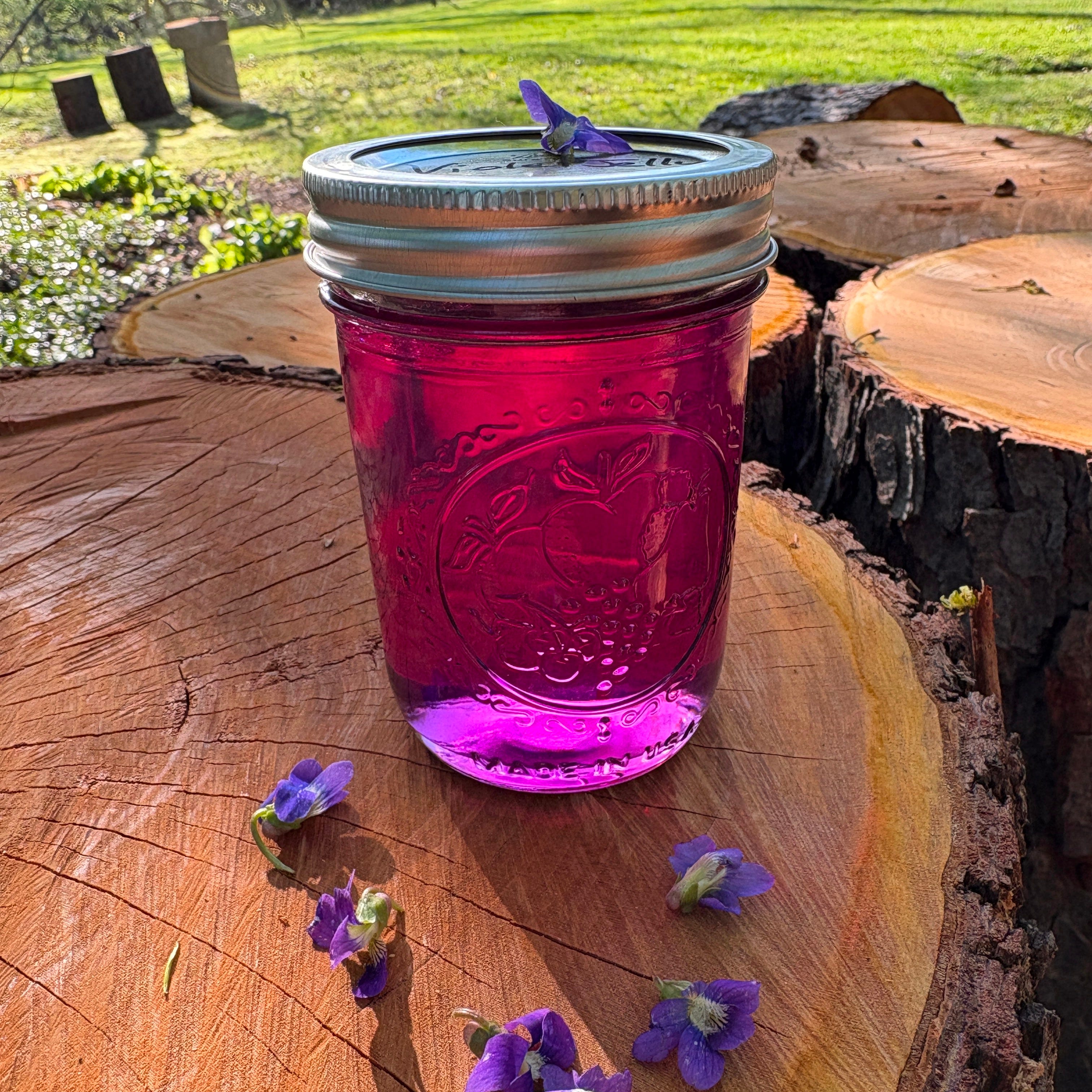
There are two words that are whispered in certain circles at this time of year. “They’re up.” Those words refer to morels, and they are indeed up and quite fruitful this year. But this post is not about morels. Morels are insistent and manly; their conical emergence lights a fire in some, breeding competition. This year, I’m focusing on the feminine side of a spring ephemeral—violets. Gentle flowers, demure; even their name is a soft sigh. There are plenty of those around; they are mostly ignored and readily available. And they make a beautiful jelly.
Years ago, my friend Moira and I used to attend annual symposiums called “Herbal Delights” organized by the Pennsylvania Heartland Chapter of the Herb Society of America. The events were as charming and old-fashioned as they sound. At the 1988 symposium, Leona Woodring Smith, author of The Forgotten Art of Flower Cookery, presented a talk on “St. Fiacre—Patron Saint of Gardeners.” I don’t remember the talk about the 7th-century Irish monk, but I purchased Mrs. Smith’s book at her book-signing afterward and still find it enchanting.
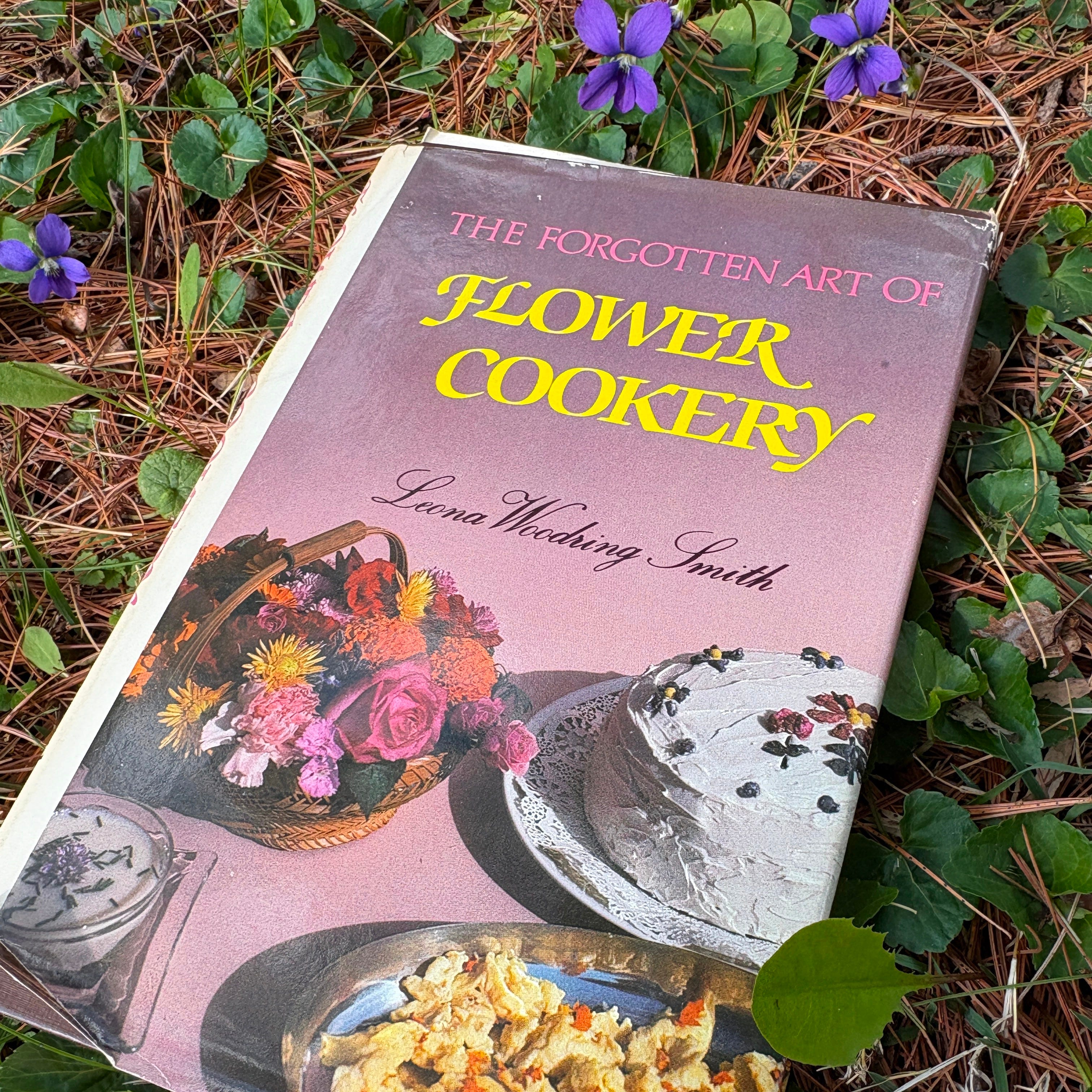
The chapter on violets contains 30 recipes and tips for using the flowers. Some show their age, as in the Violet Canapes recipe made with a jar of pineapple cheese spread and a can of deviled ham, flavored with Madeira, curry powder, and garlic salt. But many have a lingering appeal—a salmon salad with cucumber or avocado, capers, and fresh tarragon. Both dishes are garnished with violets.
I tried two recipes from the chapter, which required quite a lot of violet gathering. The Violet Jam was very easy and quick to make, though I would caution using a Vitamix for blending the violets and sugar, and then for adding the hot pectin mixture. I don’t think a domestic blender could handle the amount of sugar, since it bubbled over the top of the Vitamix. Caution is advised.


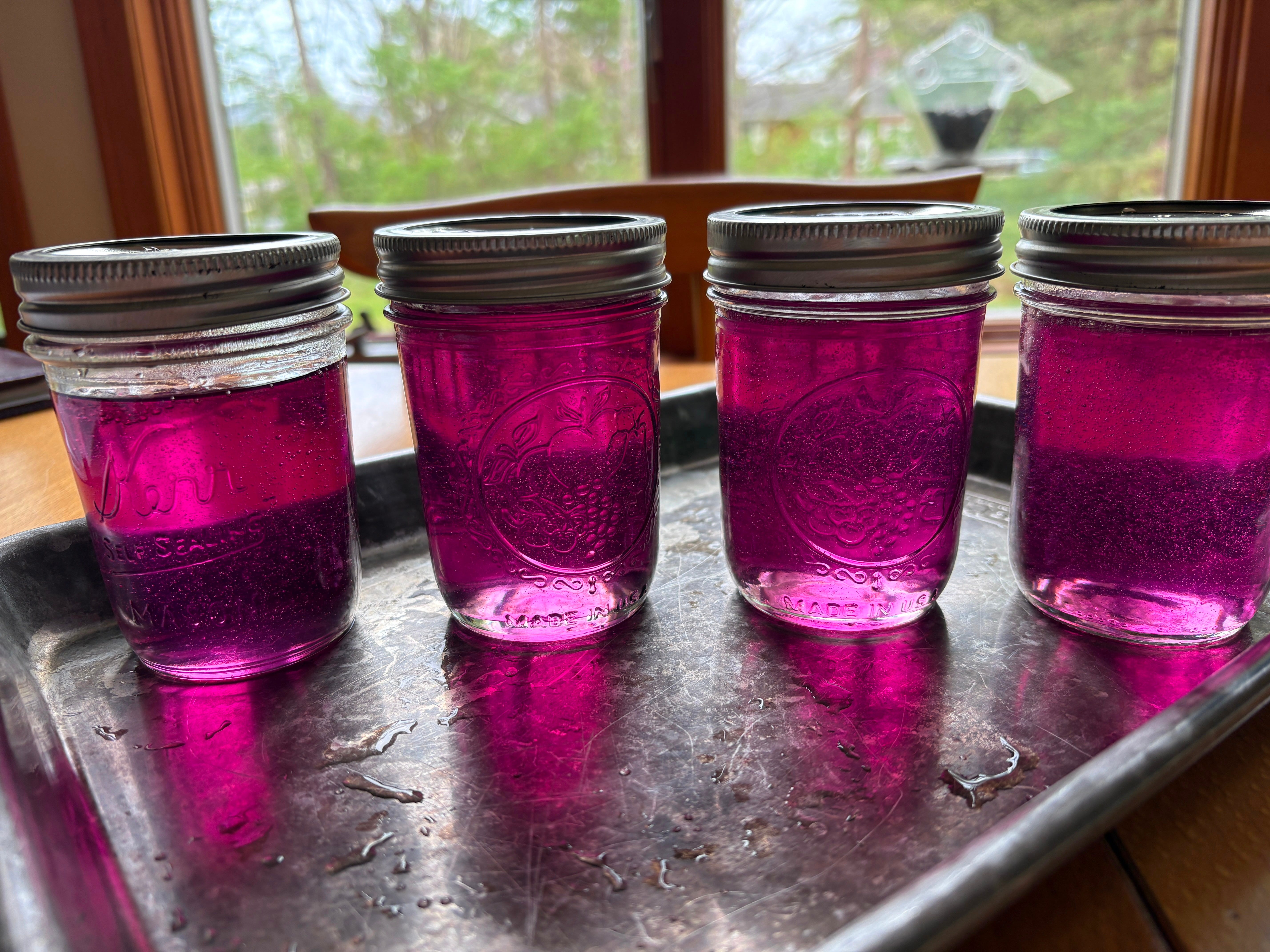
The Violet Jelly recipe recommended a double infusion for a deeper color and flavor. I picked another small bowl of violets, infused them with boiling distilled water in a glass jar, and let the mixture rest in the refrigerator overnight. The next day, I drained the infusion, heated the pale blue liquid, and infused a fresh batch of blossoms. The result was worth the effort.


These three recipes are from The Forgotten Art of Flower Cookery by Leona Woodring Smith
Violet Jam
Makes 6 medium jars (what size, Leona?)
1 1/2 cups violet flowers
1 1/2 cups water
3 tablespoons lemon juice
3 cups sugar
1 package fruit pectin (Sure Jell)
Put the violets, 3/4 cup of the water, and the lemon juice into your blender (use a Vitamix!) and blend at high speed for 1 minute. Add the sugar and blend for another 60 seconds.
Stir the pectin into the remaining water and boil for a full two minutes, stirring constantly. Pour this hot mixture into the blender and blend for another 2 minutes. Pour into jars and seal. Store in your freezer.
No vitamins are lost in this process and you retain the fresh flavor of the violets.
Violet Water
Violets release their flavor and coloring very readily if placed in a glass jar or crock (do not use metal) and boiling water to cover them is added. Place a lid on the container and let stand overnight. (Use distilled water for best results.) Strain and use the liquid to color drinks, gelatin, icings, sauces, etc. If you prefer stronger flavor or coloring you may reheat the liquid and pour over a fresh batch of flowers.
Violet Jelly
5 medium jars (Again, size? not the 8-ounce ones that I used.)
1 1/2 cups violet water (double-infused for deeper color)
1 tablespoon lemon juice
3 1/2 cups sugar
1/2 bottle fruit pectin (Certo) (I used the entire pouch of liquid pectin)
Combine the violet water, lemon juice, and sugar in a large pan. Place over high heat and bring to a boil, stirring constantly. Stir in the fruit pectin and boil hard for one full minute, stirring constantly.
Remove from the heat. (Leona recommends one or two drops of both red and blue food coloring here for deeper color, but I don’t. These recipes are from a different time.)
Skim off the foam with a metal spoon and pour into glasses.
To some glasses, add a rose-geranium leaf for additional taste and eye appeal. (I wouldn’t do that either.)
Note: I did not process the jelly in a boiling water canner because there was no actual fruit or veg in it. I used sterilized glass jelly jars and put new lids into hot water so they would seal. I did hear them pop, so I know that they are safe. And there aren’t many jars—they won’t last long.
For the true violet aficionado, here is some more lore.
The following two paragraphs, recipe, and photo were from my Centre Daily Times article published on May 9, 2001.
Violaceae, the viola family, includes wild violets, cultivated violas, pansies, and Johnny-jump-ups. In Europe, v. tricolor, with its yellow, purple, and white markings, is known as “heart’s ease.” The Latin word viola means “sweet-smelling flower,” and indeed V. odorata has been treasured for millennia as an herbal medicine and a food. The ancient Greeks, who named the flower the emblem of Athens, were not the only ones enamored of the plant. Chinese, Native American, and Ayurvedic health practitioners across temperate climate zones used the plant's many parts in tinctures, poultices, and as a salad herb. A cure for a variety of ailments, the viola family was listed in John Gerard’s Herball, first published in England in 1597: “It has power to ease inflammations, roughness of the throat and comforteth the heart, assuageth the pains of the head and causeth sleep.” As far back as 500 BC, it was used as a poultice for skin cancer and lesions, a practice that continued in various parts of the world until the twentieth century.
Violets have long been associated with innocence, faithfulness, and love. They were the favorite flower of Napoleon, who marked his anniversaries with Josephine by sending her violets, and who was buried with a locket containing faded violets from her grave. In ancient Persia, sherbets were flavored with the flowers, and in Rome, a perfumed wine was made from the blossoms. This decoction was also considered a love potion.
(Here’s a recipe not included in Leona’s book, but it can only be made in the spring. One of these days, I’ll make it again. It’s a keeper.)
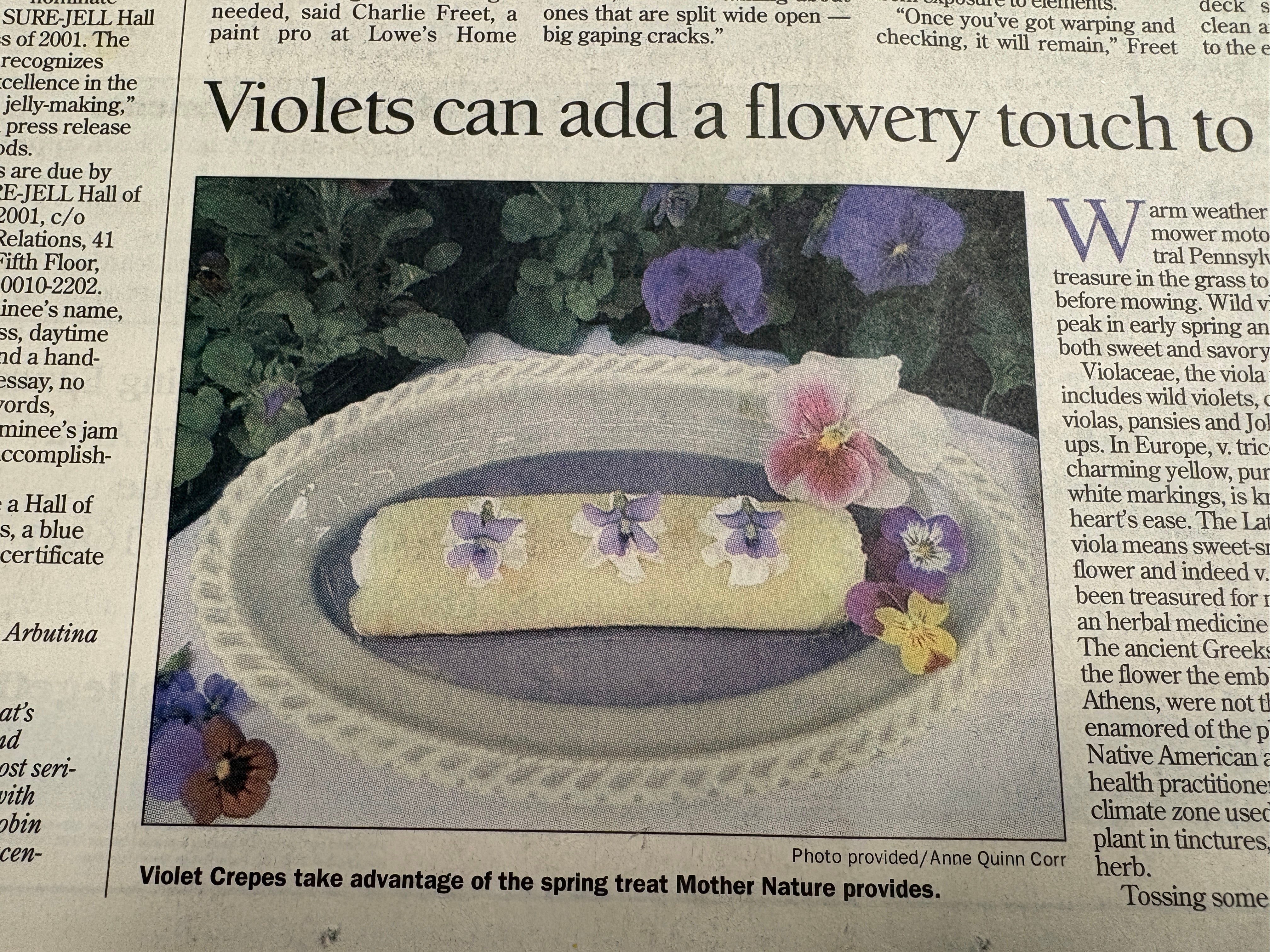
Lemon Crepes with Violet-Vanilla Cream Filling and Violet Syrup
Serves 8
Crepes:
2 large eggs
1 cup milk
3/4 cup unbleached flour
1/4 teaspoon sea salt
1 tablespoon sugar
2 tablespoons melted unsalted butter
zest of one lemon
Syrup:
1 cup water
4 tablespoons sugar
1 1/2 cups violets, stems removed
1/2 teaspoon white wine vinegar
Filling:
One cup heavy cream (Meyer’s Dairy cream is best)
3 tablespoons sugar
1/2 teaspoon real vanilla
15 ounces ricotta cheese
freshly grated nutmeg to taste
1 cup violet, Johnny-jump-up, or pansy petals, snipped with scissors if large
Garnish:
1/2 cup heavy cream, whipped until stiff
Additional perfect violet blossoms
Crepes:
In a blender or in a bowl with a whisk, combine the eggs, milk, flour, salt, sugar, and melted butter. Blend or whisk until smooth, and then allow the batter to rest for at least an hour. (Can be prepared a day ahead.) Add the lemon zest when you are ready to prepare the crepes. Heat a crepe pan over medium heat until hot. Spray the pan with cooking spray, then pour in just enough batter to coat the bottom as thinly as possible. Cook for about 30 seconds until the top surface of the crepe appears dry and the edges begin to curl. Flip the crepe over and cook the other side briefly, taking care not to brown it. Stack the crepes on a plate, cover tightly, and refrigerate until ready to fill.
Syrup:
Combine the water and sugar in a small, heavy-bottomed saucepan and bring to a boil to dissolve the sugar. Add the violets and simmer over medium-high heat for about 15 minutes or until reduced by half. Stir occasionally. The liquid may appear greenish due to chlorophyll in the plant. Add the vinegar and observe the color change as the anthocyanin (reddish-purple) pigment reacts with the acid. Voila—violet! Strain the syrup through a sieve, pressing to remove all the juice from the petals. You will have about 1/2 cup of the syrup.
Filling:
Whip the cream with the sugar and vanilla until stiff peaks form. Fold in the ricotta, nutmeg, and flower petals.
Assembly:
Fill each crepe with about 1/2 cup of the filling mixture, then place it on a plate with the seam side down. Drizzle about 1 tablespoon of the violet syrup around the crepe and garnish with several dollops of whipped cream topped with violet blossoms.
.
What a treasure trove of information- the pictures alone!!! 💟💟💟💟
Yum! Kirk and Iris would love to make this. We will watch for violets this spring - they bloom in jordan canyon.